
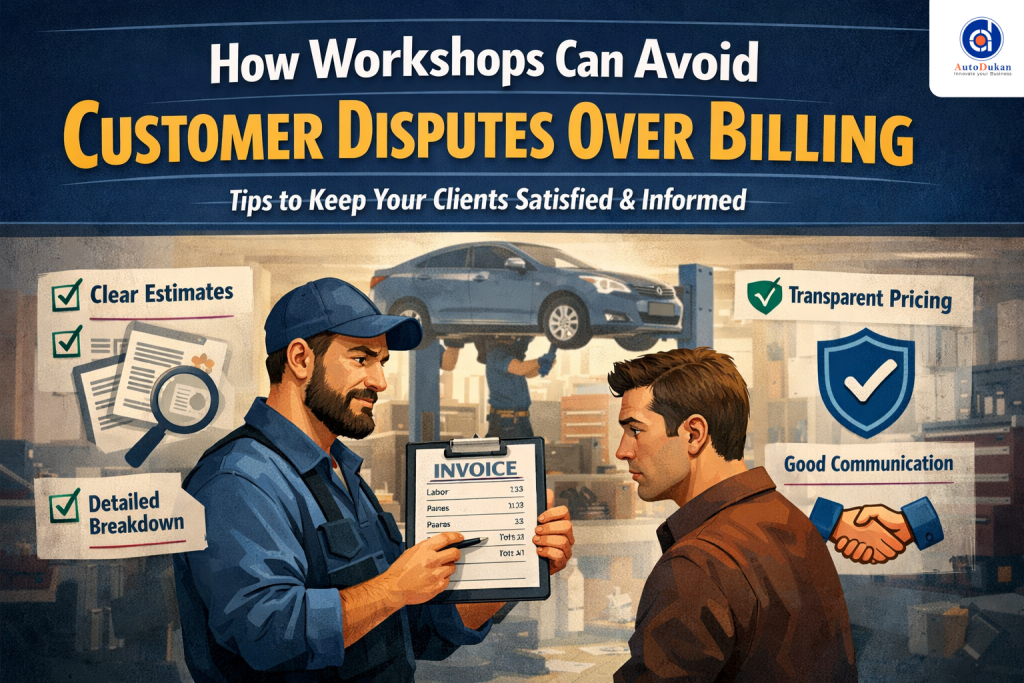
Billing disputes are one of the fastest ways for a workshop to lose customer trust. Most disputes do not occur because the bill is high. They occur because the customer did not expect the bill to be high.
When the final invoice feels different from what the customer imagined, frustration begins. Understanding how to avoid customer disputes in car workshop billing is therefore less about pricing and more about transparency, process discipline, and expectation management.
Workshops that rarely face billing disputes usually follow clear communication practices before, during, and after repairs.
Most Billing Disputes Start Before the Repair Begins
The first mistake often happens when work starts without a clear estimate. A technician may begin diagnosing or dismantling a vehicle while the customer assumes the repair will remain within a certain budget.
When additional faults appear during inspection, the cost naturally increases. If the customer was not informed in advance that further issues might surface, the updated bill feels like an unexpected escalation.
Workshops can avoid this by sharing a rough estimate range before starting work and explaining that hidden issues may appear once the vehicle is opened.
Clear expectation setting prevents surprises later.
Written Estimates Create Accountability
Verbal estimates are easily misunderstood. A customer might remember a number differently from what the technician said.
Providing a written estimate removes this ambiguity. Even a simple digital message or job card showing expected labour cost, part cost, and possible additional work creates clarity.
When customers see the estimate before approving the job, they feel included in the decision process.
Update Customers Before Adding Additional Work
Many repairs reveal secondary problems once parts are removed. For example, replacing brake pads may reveal worn discs, or suspension noise may expose multiple worn components.
The critical step is to inform the customer before continuing the repair.
If additional work is performed without approval, customers may assume unnecessary work was added to increase the bill. A quick call or message explaining the newly discovered issue maintains transparency.
Break Down Bills Clearly
Confusing invoices often trigger disputes. When customers see a single total amount without understanding how it was calculated, they may assume charges are arbitrary.
A clear invoice should separate:
- Labour charges
- Spare parts cost
- Additional materials or fluids
This breakdown helps customers understand what they are paying for and why the cost reached the final amount.
Delivery Time Affects Billing Perception
Billing disputes sometimes arise because customers are already frustrated with delays. When a repair takes longer than expected, customers become more sensitive to the final invoice.
Even if the bill is correct, the negative experience around delays makes it feel unfair.
Maintaining realistic timelines and informing customers early about delays helps prevent this emotional trigger.
Also Read: How to Reduce Customer Complaints in a Car Workshop
Parts Accuracy Prevents Billing Conflicts
Incorrect or incompatible parts often lead to repeat work. If a component fails shortly after installation, customers may question the entire invoice.
In some cases, workshops must redo the work or replace the part again, which creates tension about who should bear the cost.
Ensuring part compatibility before installation prevents these situations.
Also Read: How to Check Spare Part Compatibility Before Ordering in Indian Workshops
Transparency Builds Long Term Trust
Workshops that consistently communicate openly about costs rarely face aggressive disputes. Customers become comfortable approving repairs because they trust the process.
Transparency does not mean offering the cheapest service. It means ensuring the customer understands the value of the work being done.
Over time, this builds a reputation for fairness and professionalism.
Where Accurate Parts And Pricing Support Billing Clarity
Many billing disputes originate when incorrect parts are installed or pricing changes during sourcing. Using a reliable parts platform reduces these uncertainties.
Autodukan enables workshops to source genuine OEM spare parts with accurate compatibility and transparent pricing. When parts pricing and fitment are clear from the start, workshops can prepare accurate estimates and avoid billing misunderstandings.
Conclusion
Avoiding customer disputes in car workshop billing requires more than competitive pricing. Clear estimates, written approvals, transparent invoices, and proactive communication create confidence throughout the repair process.
Workshops that treat billing as part of customer experience rather than a final step significantly reduce conflicts and build stronger long term relationships.
FAQs
Why do billing disputes happen in car workshops?
They usually occur when repair costs exceed customer expectations without prior communication.
Should workshops provide written estimates?
Yes. Written estimates prevent misunderstandings and create transparency.
Can incorrect parts cause billing disputes?
Yes. Repeat repairs caused by incompatible parts often lead to customer dissatisfaction.