
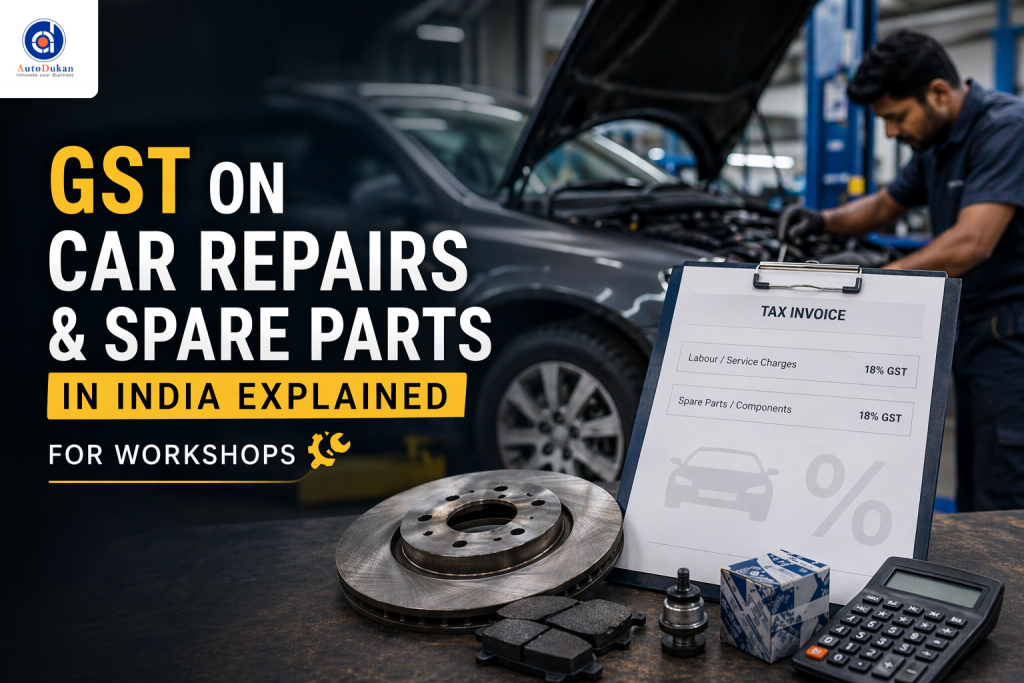
GST has standardised taxation across India, but for workshops, it has also introduced complexity in billing, compliance, and pricing.
Most confusion around GST on car repairs in India comes from mixing labour and parts incorrectly or misunderstanding input tax credit.
Understanding how GST applies helps workshops price jobs correctly and avoid compliance issues.
GST On Labour And Spare Parts Is Different
One of the biggest misconceptions is treating the entire bill as a single category.
- Labour attracts 18 percent GST
- Spare parts usually attract 18 percent or 28 percent depending on category
Mixing both incorrectly leads to wrong billing and compliance risks.
Composite Vs Mixed Supply
If labour and parts are billed together without separation, it may be treated differently under GST rules.
Workshops should:
- Clearly separate labour and parts in invoice
- Avoid bundling unless structured correctly
This ensures correct tax calculation.
Input Tax Credit Is A Major Advantage
GST allows workshops to claim input tax credit on purchases.
This means:
- GST paid on spare parts can be adjusted
- Reduces overall tax burden
However, this is only possible if:
- Purchases are properly recorded
- Vendor invoices are compliant
Billing Errors Create Long Term Issues
Incorrect GST application may not show immediate impact but creates problems during audits.
Common mistakes:
- Wrong GST rate
- No separation between labour and parts
- Missing GST details on invoice
Workshops should standardise billing templates.
Also Read: How Workshops Can Avoid Customer Disputes Over Billing
Pricing Transparency Builds Trust
Customers often do not understand GST breakdown. If the invoice is unclear, it creates confusion and disputes.
Clear billing with:
- Labour charges
- Parts cost
- GST separately mentioned
improves trust and reduces friction.
Where Structured Sourcing Supports GST Accuracy
Correct invoicing depends on correct part sourcing.
AutoDukan helps workshops with transparent pricing and GST compliant invoices for genuine OEM parts. This simplifies input credit and ensures billing accuracy.
Conclusion
GST on car repairs in India is straightforward when labour and parts are handled separately and correctly.
Workshops that maintain clear billing, proper records, and structured sourcing avoid compliance risks and improve customer trust.
FAQs
Is GST applicable on labour in car service?
Yes, labour attracts 18 percent GST.
Can workshops claim GST input credit?
Yes, if purchases are properly documented.
Why separate labour and parts in invoice?
To apply correct GST rates and avoid compliance issues.