
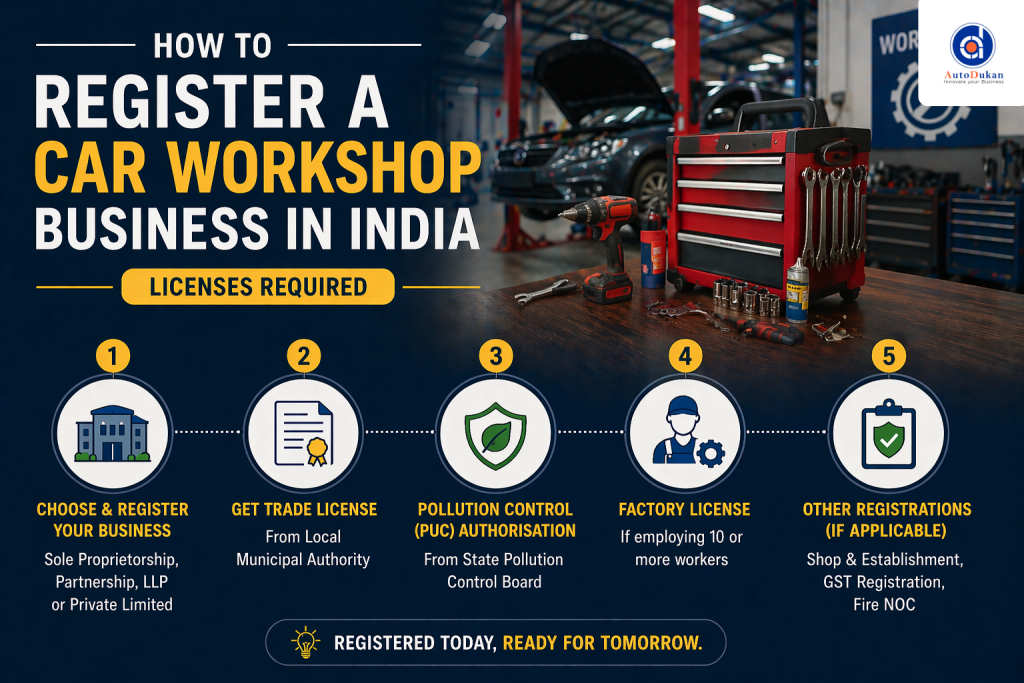
Starting a car workshop in India is not just about tools and space. It is also about compliance. Many workshops operate informally in the beginning, but as business grows, lack of proper registration creates problems in expansion, partnerships, and even basic operations.
Understanding how to register a car workshop in India helps avoid legal issues and builds a stronger foundation for growth.
Step 1: Choose The Right Business Structure
The first decision is how the business will be registered.
Options include:
- Proprietorship
- Partnership
- Private limited company
Most small workshops start as proprietorship due to simplicity. As scale increases, structured entities offer better credibility and financial flexibility.
Step 2: Shop And Establishment Registration
This is one of the most basic and essential registrations.
It allows:
- Legal operation of business
- Hiring employees
- Local compliance
Without this, the workshop technically operates outside formal regulation.
Step 3: GST Registration Becomes Necessary With Scale
GST is required if turnover crosses threshold or if workshop wants input credit.
Benefits:
- Claim tax credit on parts
- Work with corporate clients
- Maintain structured billing
Also Read: GST on Car Repairs and Spare Parts in India Explained for Workshops
Step 4: Trade License From Local Authority
Municipal authorities require a trade license to operate commercial activity.
This ensures:
- Zoning compliance
- Safety norms
- Local regulation adherence
Ignoring this can lead to fines or shutdown notices.
Step 5: Pollution And Environmental Compliance
Workshops deal with oil, chemicals, and waste.
Basic compliance includes:
- Waste disposal management
- Pollution control board guidelines
This becomes more important as scale increases.
Step 6: Fire And Safety Measures
Basic fire safety equipment is required.
For larger workshops:
- Fire NOC may be required
Safety compliance is often overlooked but critical.
Step 7: Bank Account And Financial Setup
A business bank account helps:
- Separate personal and business transactions
- Build financial credibility
This becomes important for loans and partnerships.
Where Formal Setup Supports Business Growth
Registered workshops:
- Gain customer trust
- Work with insurance companies
- Access better supply chains
Unregistered setups struggle to scale beyond a point.
Where Structured Sourcing Supports Professional Operations
As workshops formalise, sourcing becomes critical.
AutoDukan helps workshops operate professionally by providing access to genuine OEM parts with transparent pricing and reliable supply, supporting structured business operations.
Conclusion
Registering a car workshop in India is not complicated, but it requires awareness of key steps. Business structure, licenses, GST, and compliance form the base of a scalable operation.
Workshops that formalise early are better positioned to grow, build trust, and operate smoothly.
FAQs
Is GST mandatory for car workshop?
Only after threshold, but beneficial earlier.
Which license is most important?
Shop and establishment registration is basic requirement.
Can workshop run without registration?
Informally yes, but it limits growth and creates risk.