
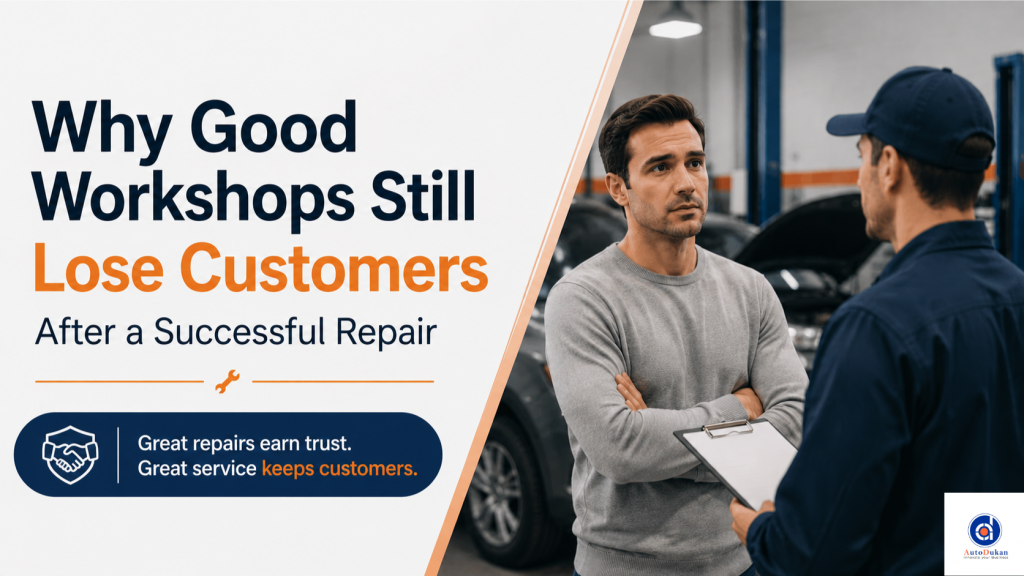
Many workshop owners assume a successful repair automatically creates a returning customer. The logic feels reasonable. The car was fixed correctly, the customer paid, and there were no complaints.
Yet many workshops still see customers disappear after what looked like a positive experience.
The reason is simple. Customers rarely judge a workshop only by whether the problem was solved. They judge the entire experience around the repair.
Understanding why workshops lose customers requires looking beyond mechanical work and into behaviour, communication, and customer memory.
Good Repairs Are Expected, Not Memorable
Many workshops believe fixing the issue correctly is enough to build loyalty. The reality is different.
Customers expect repairs to work. They do not view it as an extra benefit. It is the baseline requirement.
What they actually remember:
- How clearly things were explained
- Whether timelines were respected
- Whether surprises appeared later
- How easy the process felt
A technically excellent repair with a poor experience often loses against a workshop with a slightly better customer journey.
Customers Remember Stress More Than Repair Quality
Imagine two situations.
Workshop A fixes the issue perfectly but:
- Delays delivery twice
- Does not update the customer
- Adds unexpected costs later
Workshop B fixes the issue similarly but:
- Gives realistic timelines
- Updates progress regularly
- Explains costs clearly
Months later, customers often remember Workshop B more positively.
People remember how difficult or easy the experience felt.
Silence After Delivery Quietly Ends Relationships
Many workshops stop interacting the moment the invoice is paid.
From the workshop’s perspective, the job is complete.
From the customer’s perspective, ownership continues.
Simple actions create long term recall:
- Service reminders
- Follow up messages
- Checking whether the car is performing well
Customers often return to the workshop that remains visible.
Also Read: How to Improve Customer Retention in a Car Repair Workshop Without Discounting
Small Trust Gaps Build Bigger Problems
Trust loss rarely happens through one major incident.
It usually develops through small moments:
- Estimated completion by evening becoming next day
- Different person saying something else
- Costs changing without explanation
- Unclear invoices
None of these alone seem major.
Repeated together, they create uncertainty.
Customers may never complain openly. They simply do not come back.
Customers Want Predictability More Than Discounts
Many workshops assume customers leave because another garage offered lower pricing.
Price matters, but predictability often matters more.
Customers prefer knowing:
- What the repair includes
- How long it will take
- What they will pay
Unexpected experiences create more dissatisfaction than expensive ones.
The Workshop Experience Starts Before Repair Begins
Retention does not start when the car enters the bay.
It begins with:
- First phone call
- First interaction
- Estimate clarity
- Vehicle intake process
Workshops with structured processes often create stronger customer confidence before work even starts.
Also Read: How to Reduce Customer Complaints in a Car Workshop
Where Correct Parts Influence Long Term Trust
Repeat failures quietly destroy customer retention.
A customer may not understand part specifications, but they understand outcomes. If noise returns, vibration appears again, or fitment issues develop after repair, confidence drops immediately.
AutoDukan helps workshops source genuine OEM spare parts with accurate compatibility so repairs remain reliable long after delivery. Better outcomes lead to stronger customer confidence and higher retention.
Conclusion
Understanding why workshops lose customers requires looking beyond repair quality.
Good repairs bring satisfaction. Strong communication, trust, consistency, and follow up create loyalty.
Workshops that improve customer experience around the repair often retain more customers than workshops that focus only on the repair itself.
FAQs
Why do customers stop returning even after successful repairs?
Usually due to communication gaps, poor experience, or lack of follow up.
Do customers care only about repair quality?
No. They also remember the overall service experience.
Can small issues affect retention?
Yes, repeated small trust gaps often reduce customer loyalty.