
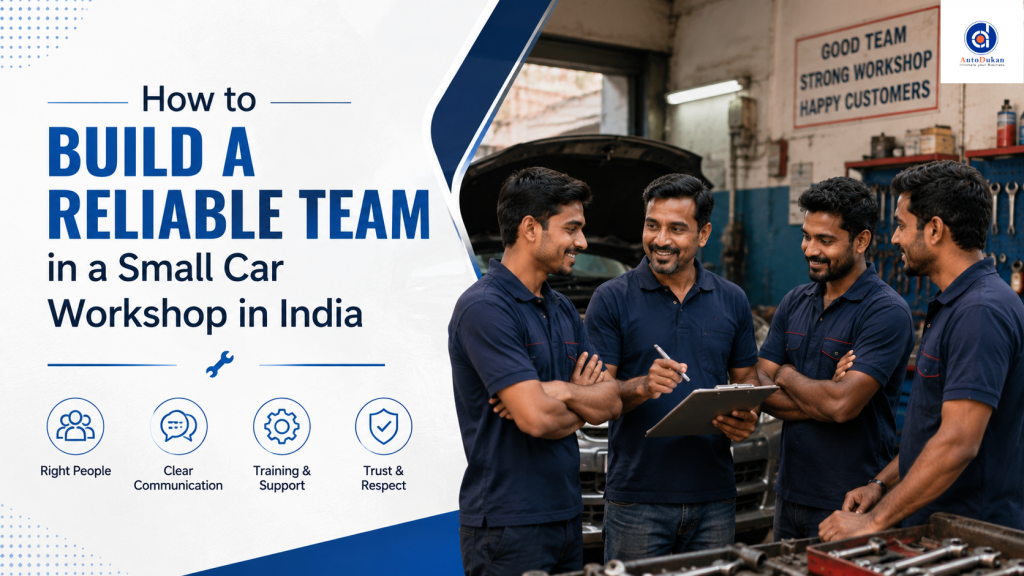
Many workshop owners believe growth depends on more customers, more bays, or better equipment. While all of these matter, the biggest limitation for most small workshops is usually the team.
A workshop can survive with limited space. It can survive with basic equipment. It struggles to survive with an unreliable team.
The challenge is that reliability is not something that appears automatically when new employees are hired. It is built deliberately through structure, culture, and leadership.
Understanding how to build a reliable workshop team is one of the most valuable investments a workshop owner can make.
Reliability Starts Before Hiring
Many hiring decisions in small workshops are made under pressure.
A technician leaves unexpectedly, workload increases, and the priority becomes filling the vacancy as quickly as possible.
This often leads to hiring based on availability instead of suitability.
When evaluating candidates, technical skill is important, but reliability indicators matter just as much.
Look for evidence of:
- Stable work history
- Willingness to learn
- Consistent attendance
- Positive references
A highly skilled technician who creates disruption often costs more than a moderately skilled technician who is dependable.
Clear Roles Reduce Internal Friction
Many workshop teams struggle because responsibilities are unclear.
When nobody knows exactly who owns a task:
- Work gets duplicated
- Tasks are forgotten
- Accountability disappears
Even small workshops benefit from defining responsibilities clearly.
Examples include:
- Vehicle intake
- Diagnostics
- Parts coordination
- Customer communication
- Quality checks
Clear ownership reduces confusion and improves consistency.
Process Reduces Dependence On Individuals
One of the biggest risks in small workshops is relying too heavily on one person.
The workshop may have:
- One diagnostic expert
- One electrical specialist
- One senior mechanic
This works until that person takes leave or resigns.
Reliable workshops document common processes so knowledge is shared rather than concentrated.
The goal is not removing expertise. It is reducing operational dependency.
Training Should Never Stop
Many workshop owners train employees only when they join.
The best teams continue learning.
Regular exposure to:
- New vehicle technology
- Diagnostic techniques
- Customer handling practices
- Workshop systems
keeps skills improving and increases engagement.
People often stay longer where they feel they are developing professionally.
Also Read: How Workshop Owners in India Can Retain Skilled Mechanics and Reduce Staff Turnover
Accountability Works Better Than Constant Supervision
Some owners try to improve reliability by monitoring everything personally.
This becomes difficult as the workshop grows.
A better approach is creating accountability systems.
Examples include:
- Job cards
- Inspection checklists
- Delivery verification processes
When responsibilities are visible, reliability improves naturally.
Strong Teams Share Information
Poor communication creates many workshop problems.
Examples include:
- Parts ordered incorrectly
- Jobs assigned twice
- Customer commitments being missed
Reliable teams develop habits of sharing information consistently.
Short daily discussions often prevent issues that later become expensive mistakes.
Culture Determines Long Term Stability
Culture sounds abstract, but mechanics experience it every day.
Questions employees ask themselves include:
- Am I respected here?
- Is effort recognised?
- Can I trust my colleagues?
- Is management fair?
Workshops with healthy culture often retain employees longer and attract better talent through reputation.
Reliability Requires The Right Tools And Support
Even motivated teams struggle when systems around them are inefficient.
Common frustrations include:
- Waiting for parts
- Incorrect part deliveries
- Rework caused by compatibility issues
- Poor workflow planning
A reliable team performs best when operational obstacles are reduced.
Also Read: How to Manage Multiple Cars Efficiently in a Small Garage Environment
Where Reliable Operations Support Reliable Teams
Technicians are more productive when they can focus on repairs instead of chasing parts and resolving sourcing issues.
AutoDukan helps workshops access genuine OEM spare parts with accurate compatibility and transparent pricing. Better sourcing reduces delays, improves workflow consistency, and supports a more reliable working environment.
Conclusion
Learning how to build a reliable workshop team is not about finding perfect employees. It is about creating conditions where reliability can thrive.
Clear roles, structured processes, ongoing training, accountability, and strong culture all contribute to long term team stability.
Workshops that invest in building reliable teams often discover that growth becomes easier, customer satisfaction improves, and operational stress decreases significantly.
FAQs
What makes a workshop team reliable?
Clear responsibilities, accountability, training, and strong communication.
Should small workshops document processes?
Yes. It reduces dependency on individual employees and improves consistency.
How can workshops improve team retention?
By offering growth opportunities, fair treatment, and organised operations.