
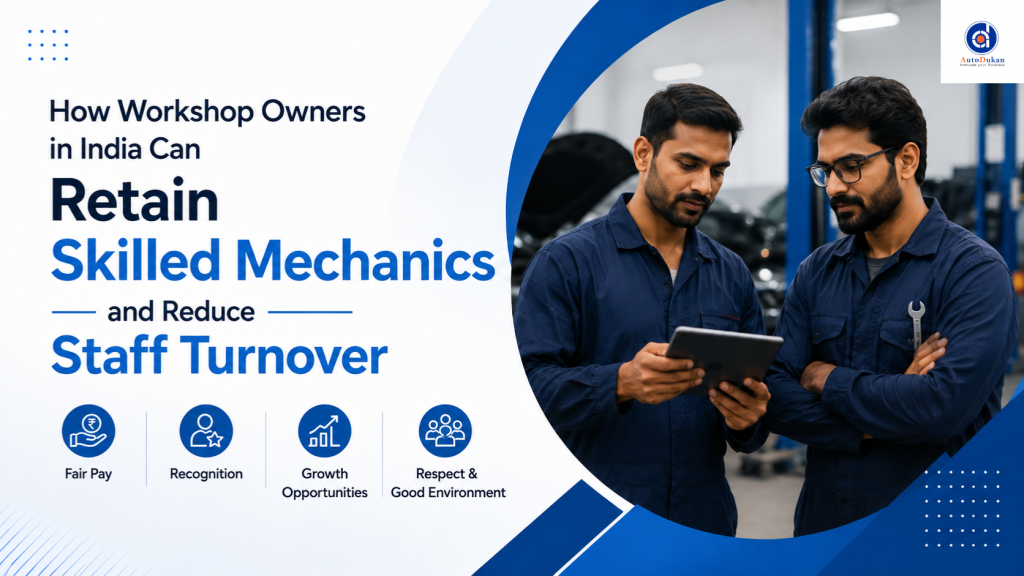
Most workshop owners believe mechanics leave because of salary. While pay matters, it is rarely the full story.
Across India, many mechanics leave workshops offering competitive wages and join others for only a modest increase. Some leave the industry entirely. Others move repeatedly between garages every few months.
The real challenge is understanding why skilled mechanics stay in one workshop and leave another.
Knowing how to retain skilled mechanics requires looking beyond compensation and understanding the daily realities of workshop life.
Skilled Mechanics Do Not Leave Jobs They Leave Situations
One of the biggest misconceptions in the industry is that retention is purely financial.
When experienced mechanics decide to leave, common reasons include:
- Constant workplace conflict
- Unclear responsibilities
- Poor job allocation
- Lack of respect from management
- Limited future growth
Salary often becomes the final reason cited because it is easier to discuss than deeper frustrations.
Many turnover problems actually begin months before resignation.
Unpredictable Work Allocation Creates Frustration
Skilled mechanics generally want challenging and meaningful work.
Problems arise when:
- One technician gets overloaded
- Another sits idle
- Job allocation feels unfair
Over time, productive employees start feeling punished for being capable.
A workshop may think it is rewarding efficiency, but the mechanic often experiences it as constant pressure.
Fair workload distribution is one of the most overlooked retention tools.
Respect Matters More Than Many Owners Realise
In workshops across India, experienced mechanics often become the unofficial problem solvers.
Customers trust them. Junior staff learn from them. Complex jobs get assigned to them.
Yet many owners only acknowledge mistakes while treating good work as normal.
Recognition does not need to be expensive.
Simple actions matter:
- Asking for technical input
- Appreciating difficult repairs
- Involving senior mechanics in decisions
People are more likely to stay where they feel valued.
Career Stagnation Pushes Good Talent Away
Many mechanics eventually reach a point where every day feels identical.
The work continues, but development stops.
Workshops that retain talent often create progression through:
- Advanced diagnostics exposure
- Team leadership opportunities
- Training programmes
- Specialist responsibilities
Growth does not always require promotions. It requires visible future opportunities.
Poor Workshop Organisation Increases Burnout
Mechanics rarely enjoy spending time searching for tools, waiting for parts, or dealing with avoidable delays.
Repeated workflow inefficiencies create frustration because skilled technicians spend less time doing skilled work.
Common examples include:
- Cars occupying bays while waiting for parts
- Missing tools
- Repeated interruptions
- Poor job scheduling
These issues gradually reduce job satisfaction.
Also Read: How to Manage Multiple Cars Efficiently in a Small Garage Environment
Team Culture Influences Retention More Than Owners Expect
People often stay because of colleagues as much as compensation.
A workshop with:
- Frequent arguments
- Internal competition
- Blame culture
will struggle to retain talent.
Strong teams usually share:
- Mutual support
- Knowledge sharing
- Respect between senior and junior staff
Healthy culture reduces turnover significantly.
The Best Mechanics Want Stability
Experienced technicians usually prefer predictable environments.
They value:
- Consistent income
- Organised operations
- Professional management
Workshops that constantly change processes, priorities, or expectations create uncertainty.
Stability often becomes a competitive advantage in retention.
Why Retention Is More Profitable Than Constant Hiring
Replacing experienced mechanics is expensive.
The visible costs include:
- Recruitment
- Training
- Reduced productivity
The hidden costs are even larger:
- Delayed jobs
- Customer dissatisfaction
- Knowledge loss
A workshop with low turnover often performs more consistently than a workshop constantly replacing staff.
Where Better Systems Support Better Retention
Mechanics are more likely to stay when they can complete jobs efficiently and confidently.
AutoDukan helps workshops reduce sourcing delays and compatibility issues by providing access to genuine OEM spare parts with accurate vehicle matching. Smoother workflows reduce frustration and allow technicians to focus on repairs instead of chasing parts.
Conclusion
Learning how to retain skilled mechanics is ultimately about creating an environment where good technicians can do their best work.
Fair workloads, professional respect, growth opportunities, organised operations, and strong team culture all contribute to long term retention.
Workshops that invest in their people often discover that staff stability becomes one of their strongest competitive advantages.
FAQs
Why do skilled mechanics leave workshops?
Usually due to workplace issues, limited growth, and poor organisation rather than salary alone.
How can workshops improve mechanic retention?
By creating fair workloads, career growth opportunities, and a supportive culture.
Does workshop organisation affect staff turnover?
Yes. Repeated delays and inefficient processes increase frustration and burnout.